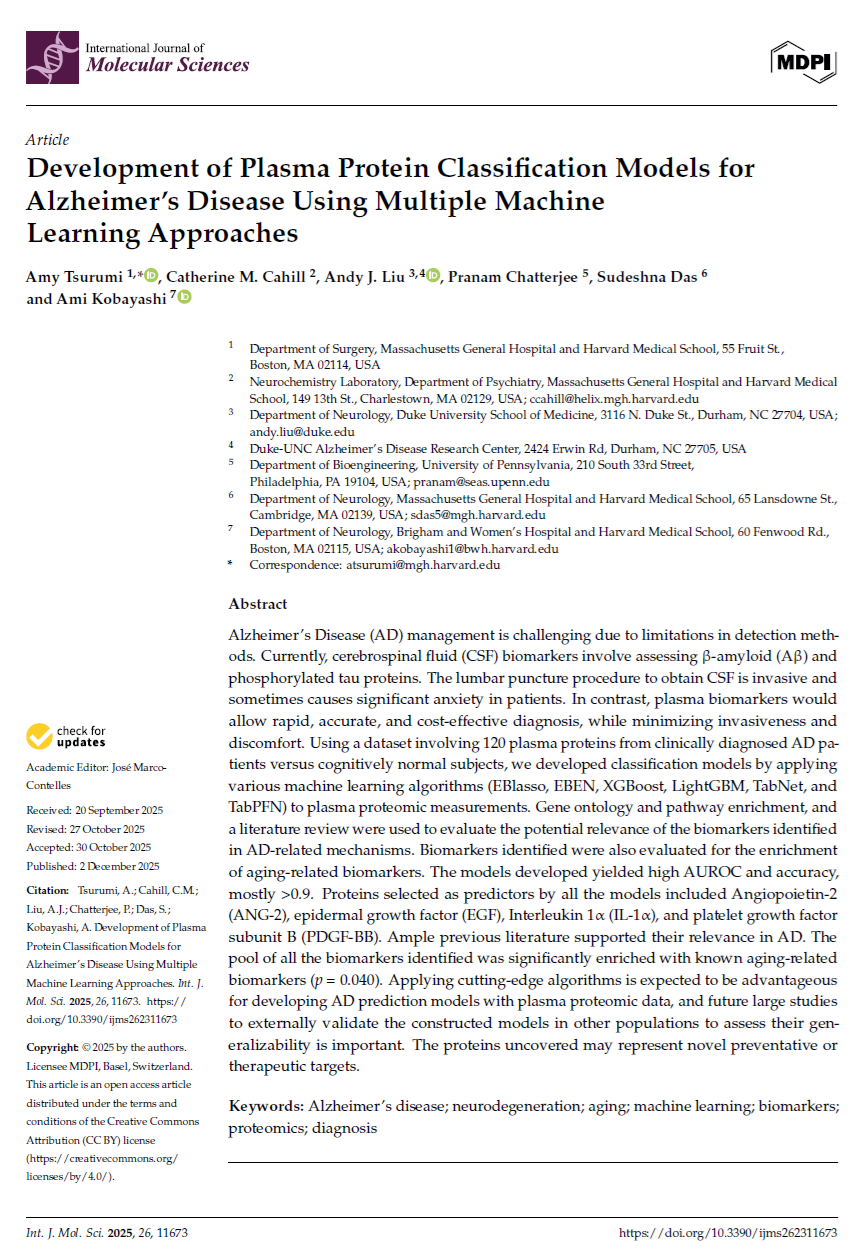
Machine learning applications for novel biomarker & target discovery.
Alzheimer’s Disease
Alzheimer’s Disease cases among those 65 years and older in the United States are currently estimated to be 7.2 million (approximately 1 in 9) and are projected to further increase to 13.8 million by 2060 [1]. It is the most common basis for dementia and the sixth leading cause of death. These dire figures highlight the need for additional strategies for Alzheimer’s management.
Our goal is to develop novel biomarkers to improve the sensitivity and specificity of Alzheimer’s detection and increase modes of longitudinal monitoring to detect disease signals earlier. To better implement a personalized medicine approach, we apply a variety of machine learning algorithms to analyze proteins beyond Amyloid beta and Tau peptides, and develop new prediction methods. Our proof-of-concept results was recently published, showing high accuracy [2], and we are currently performing a multi-site study analyzing additional proteins to improve our biomarker discovery and validation.
———
[1] Alzheimer’s Association. Alzheimer’s Disease Facts and Figures, 2025. https://www.alz.org/alzheimers-dementia/facts-figures
[2] Tsurumi A, Cahill CM, Liu AJ, Chatterjee P, Das S, Kobayashi A. Development of Plasma Protein Classification Models for Alzheimer's Disease Using Multiple Machine Learning Approaches. Int J Mol Sci. 2025 Dec 2;26(23):11673. doi: 10.3390/ijms262311673. PMID: 41373821; PMCID: PMC12692058.